 English
English
One of the key shifts in modern society is a shift toward green technologies and low-carbon energy sources. This fundamentally shifts our role from consumer of raw materials to user of raw materials. Raw materials such as wood, coal, oil, petrol, and even uranium are physically consumed during their use and cannot be recovered. However, many components of modern technologies are not consumed (i.e. metals remain metals). Thus, there is the possibility that once a raw material is in the value chain it can foreseeably be maintained, recycled and repurposed. This approach to sustainable use of raw materials is especially useful when considering critical raw materials.
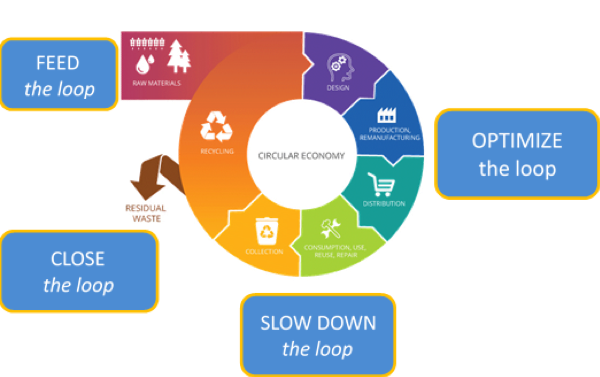
Critical raw materials are identified based on how vulnerable the supply chain is. A range of ores and metals are considered vulnerable. If Europe can source and mine their own metals, this can help reduce vulnerability. Another focus is to be able to recycle material, keeping material in the supply chain instead of it going to waste. This is one of the principles of the circular economy concept. A circular economy is an economic system aimed at eliminating waste and keeping resources within the production cycle. It builds in sustainable design from the inception of a product through the entire life cycle of the product thereby extending the use of materials. In this model, material is not discussed in terms of life-cycle or ‘cradle to grave’ but rather the ideas of reusing, sharing, repairing, refurbishing, remanufacturing and recycling are used to create a closed system, minimising the use of material and energy resources and the creation of waste, pollution and emissions.
In order to appreciate the challenges critical raw materials pose for economic and technological development we can ask ourselves several questions:
These questions fit into three themes:
These fall within the model of developing a Circular Economy (see Figure 27).